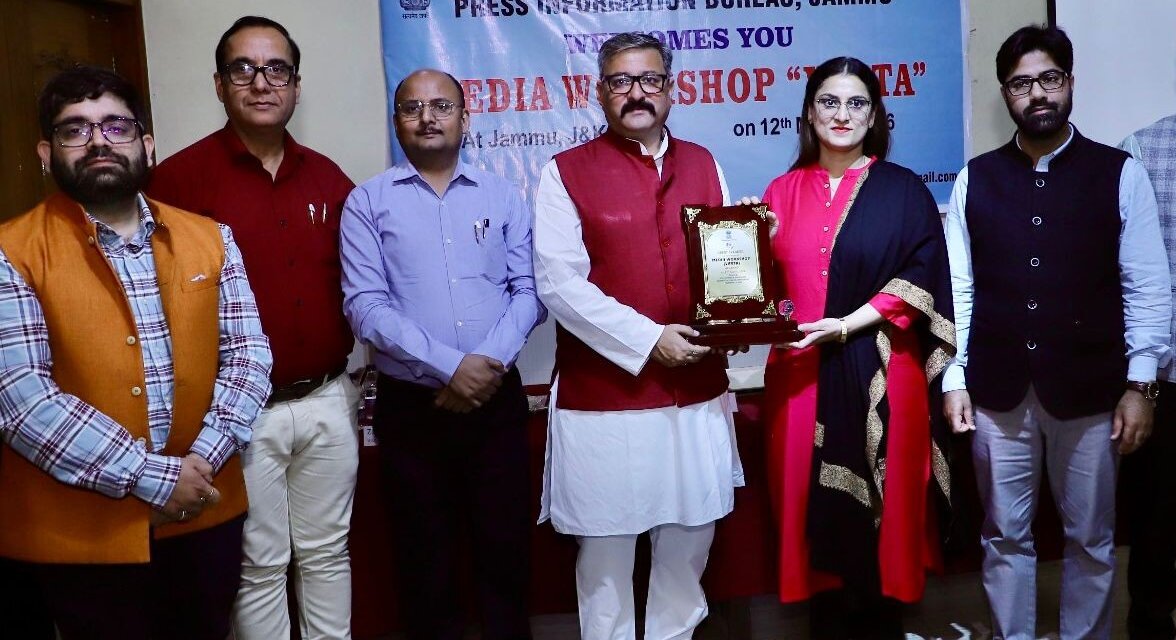
Jammu, March 12, 2026:The Press Information Bureau (PIB), Jammu organised a media workshop ‘varta’ on the theme “AI Impact Summit 2026” at Press Club here today. The programme was aimed at building awareness and capacity among journalists on the growing role of Artificial Intelligence in the media ecosystem. The workshop also featured a dedicated capacity building session on the use of AI tools for journalists to enhance productivity and improve newsroom workflows.
Speaking on the occasion, Director, PIB Jammu, Neha Jalali emphasized that accessibility, democratization of AI technology, and responsible use of artificial intelligence were the core principles of the AI Impact Summit 2026. She said Artificial Intelligence is increasingly influencing every sector, including media and communication. She emphasised the need for media professionals to collectively prepare for the evolving technological landscape and adapt to emerging AI-driven tools. She highlighted that AI offers immense potential for enhancing productivity, improving content creation, and strengthening fact-checking mechanisms in journalism.
Ms Jalali further underlined that the government is proactively advancing initiatives under the national AI mission to promote inclusive technological growth. She informed that initiatives such as IndiaAI Mission, YuvaAI, and SOAR Initiative are aimed at democratising technology and ensuring equitable access to AI tools. This, she said, would help bridge the digital divide, and enable responsible use of technology for societal good. The Director also highlighted thr initiatives of the Ministry of Information and Broadcasting, including the establishment of the Indian Institute of Creative Technology (IICT), with significant budgetary allocation to strengthen India’s media and entertainment technology ecosystem.
Speaking on the occasion, Vice President of Press Club of Jammu, Zorawar Singh Jamwal said that journalism is undergoing rapid transformation globally, and it is the need of the hour for media professionals to understand and responsibly use AI technologies. He encouraged young media professionals to become well-versed in AI tools to enhance efficiency and remain future-ready.
Addressing the participants, Vinit Utpal, Professor at the Indian Institute of Mass Communication, said that Artificial Intelligence is transforming the global media ecosystem. He said it is redefining journalism through automation, data analysis and AI-assisted content generation. He noted that newsrooms across the world are adopting AI-driven tools to enhance productivity, storytelling and information verification. He also elaborated that AI enables automated data collection, monitoring of social media trends, and real-time information analysis during breaking news situations. AI-powered tools also help journalists track information, verify data and combat misinformation.
Bhawani Singh, Assistant Professor at IIMC, Jammu, spoke about prompt engineering and the personalisation of AI tools for journalistic work. He stressed the importance of AI ethics, urging journalists to verify AI-generated outputs, clearly disclose the use of AI in content creation, and treat AI as an assistant rather than a replacement for human judgement.
Divyavasu Sharma, Business Head, 25 Technoarts, highlighted the growing relevance of AI in crisis communication and sentiment analysis. He explained how AI-driven insights can help organisations and media professionals better understand public perception and respond effectively during sensitive situations.
Earlier, in his Welcome Address, Media and Communication Officer, Zakir Nazeer said that AI Impact Summit marked a significant milestone in the global artificial intelligence landscape. He informed that the Summit witnessed extensive participation, with approximately 6 lakh attendees in person and over 9 lakh cumulative views through live virtual streaming. Delegations from more than 100 countries and 20 international organisations participated in the proceedings. The India AI Impact Summit Declaration was endorsed by 92 countries and international organisations, he added.
The workshop witnessed participation from more than 40 journalists. The workshop provided practical insights into the responsible and effective use of AI in journalism, including tools for productivity, content generation, data analysis and fact-checking.